Task-Model-Tool Alignment: Choosing the Right AI Architecture
Why AI efficiency depends on task-model-tool alignment and total token cost rather than simply adding more models, tools, and skills.
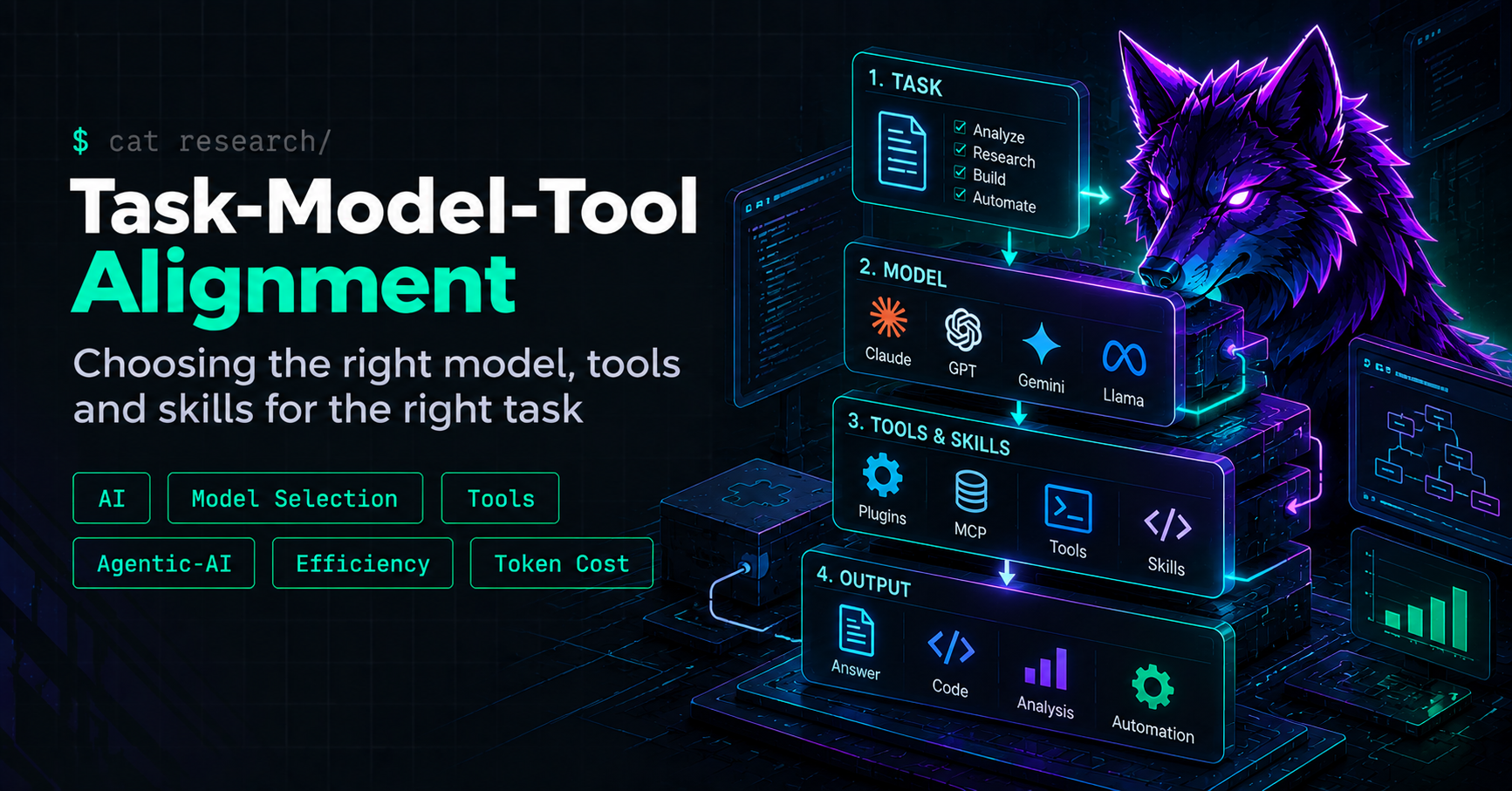
Task-Model-Tool Alignment: Choosing the Right AI Architecture
Modern AI systems can combine multiple models, tools, skills, instructions, APIs, retrieval systems, and agent workflows.
It is tempting to assume:
1
2
3
4
5
6
7
8
9
More models
    +
More tools
    +
More skills
    +
More instructions
    =
Better AI system
That does not necessarily follow.
The practical objective is task-model-tool alignment: matching the architecture to what the task actually requires.
Key Takeaways
- Different tasks require different levels of reasoning, context, and tool access.
- Additional instructions and tool definitions can become part of the context supplied to a model.
- Token usage can include input, cached input, output, and reasoning tokens, depending on the provider and model.
- Token price alone does not determine the cost of completing a task.
- A more capable model does not automatically provide better economics.
- AI systems should be optimized around completed tasks, not maximum capability.
1. Task-Model-Tool Alignment
The starting point should not be:
“What capabilities can I add?”
It should be:
“What does this task actually require?”
1
2
3
4
5
6
7
8
9
10
11
12
13
14
                    TASK
                      |
          +-----------+-----------+
          |           |           |
          v           v           v
      Reasoning    Context     Actions
          |           |           |
          v           v           v
        Model      Retrieval     Tools
          |           |           |
          +-----------+-----------+
                      |
                      v
                  EXECUTION
A simple task may require only a lightweight model and minimal context.
A complex engineering task may require stronger reasoning, repository access, search, execution tools, and multiple iterations.
The architecture should follow the workload.
2. Token Cost Analysis
Token economics are more complicated than simply comparing input-token prices.
Depending on the API and model, usage can include:
1
2
3
4
5
6
7
8
9
Input tokens
      +
Cached input tokens
      +
Output tokens
      +
Reasoning tokens
      +
Tool / service costs
Therefore:
Token Price != Total Task Cost
A lower-priced model may require more iterations, tool calls, or output to complete the same workload.
A higher-priced model may reduce the number of steps required.
Neither outcome should be assumed without measuring the actual workload.
3. Context Is Also a Resource
An AI system may provide the model with:
1
2
3
4
5
6
7
8
9
10
11
System instructions
      +
Conversation history
      +
Tool definitions
       +
Retrieved information
       +
All kind of Files
       +
Task-specific instructions
Large context can be useful when the task genuinely requires the information.
The objective is not maximum context.
It is relevant context.
4. More Capable Does Not Automatically Mean More Efficient
Consider two models:
1
2
3
4
5
6
7
8
9
10
11
12
13
14
15
16
17
18
   Model A
Lower unit cost
      |
      v
More iterations
      |
      v
Higher total workload


   Model B
Higher unit cost
      |
      v
Fewer iterations
      |
      v
Potentially lower total workload
This is a conceptual example.
Actual economics depend on the workload, token consumption, tool usage, latency requirements, and provider pricing.
The correct model is therefore a workload-dependent engineering decision.
5. The Alignment Framework
Evaluate an AI system across five layers:
| Layer | Question |
|---|---|
| Task | What must be accomplished? |
| Model | What reasoning capability is required? |
| Context | What information is necessary? |
| Tools | What external actions or data are required? |
| Cost | What is the total cost of completing the task? |
The relationship is:
1
2
3
4
5
6
7
8
9
10
11
    Task
     ↓
Required Capability
     ↓
Model + Context + Tools
     ↓
 Execution
     ↓
Token / Tool Usage
     ↓
Total Task Cost
The objective is not to maximize every layer. The objective is to keep them aligned.
6. What to Measure
For production AI systems, measure the complete workload rather than one pricing variable.
1
2
3
4
5
6
7
8
9
10
11
12
13
                 COMPLETED TASK
                       |
        +--------------+--------------+
        |              |              |
      Quality        Cost          Latency
                       |
              +--------+--------+
              |        |        |
            Input    Output  Reasoning
              |        |        |
              +--------+--------+
                       |
                  Tool Usage
Useful measurements include:
- Input tokens
- Cached input
- Output tokens
- Reasoning tokens, where applicable
- Number of model calls
- Number of tool calls
- External tool costs
- Latency
- Retries
- Successful task completion
This provides a more meaningful picture than comparing token prices in isolation.
7. Practical Rule
Before adding another model, tool, skill, or instruction, determine whether it addresses an actual requirement of the workload.
1
2
3
4
5
6
7
8
If required
    → add the capability.

If useful but optional
    → measure its impact.

If unnecessary
    → do not add it merely because it is available.
Final Principle
AI efficiency is not a capability-accumulation problem. It is an alignment problem.
1
2
3
4
5
6
7
8
9
10
11
12
13
        TASK
          +
   Required Capability
          +
   Appropriate Model
          +
    Relevant Context
          +
    Necessary Tools
          ↓
    Efficient Execution
          ↓
    Measured Task Cost
The goal is not the most capable architecture.
The goal is the architecture that provides the required capability at an appropriate total cost for the task.
Task-model-tool alignment beats capability accumulation.
References
OpenAI — Models https://platform.openai.com/docs/models
OpenAI — Responses API https://platform.openai.com/docs/api-reference/responses
OpenAI — Tools https://platform.openai.com/docs/guides/tools
Anthropic — Prompt Engineering https://docs.anthropic.com/en/docs/build-with-claude/prompt-engineering/overview
Anthropic — Model Lifecycle https://docs.anthropic.com/en/docs/about-claude/model-deprecations
```